Summer School in Portugal
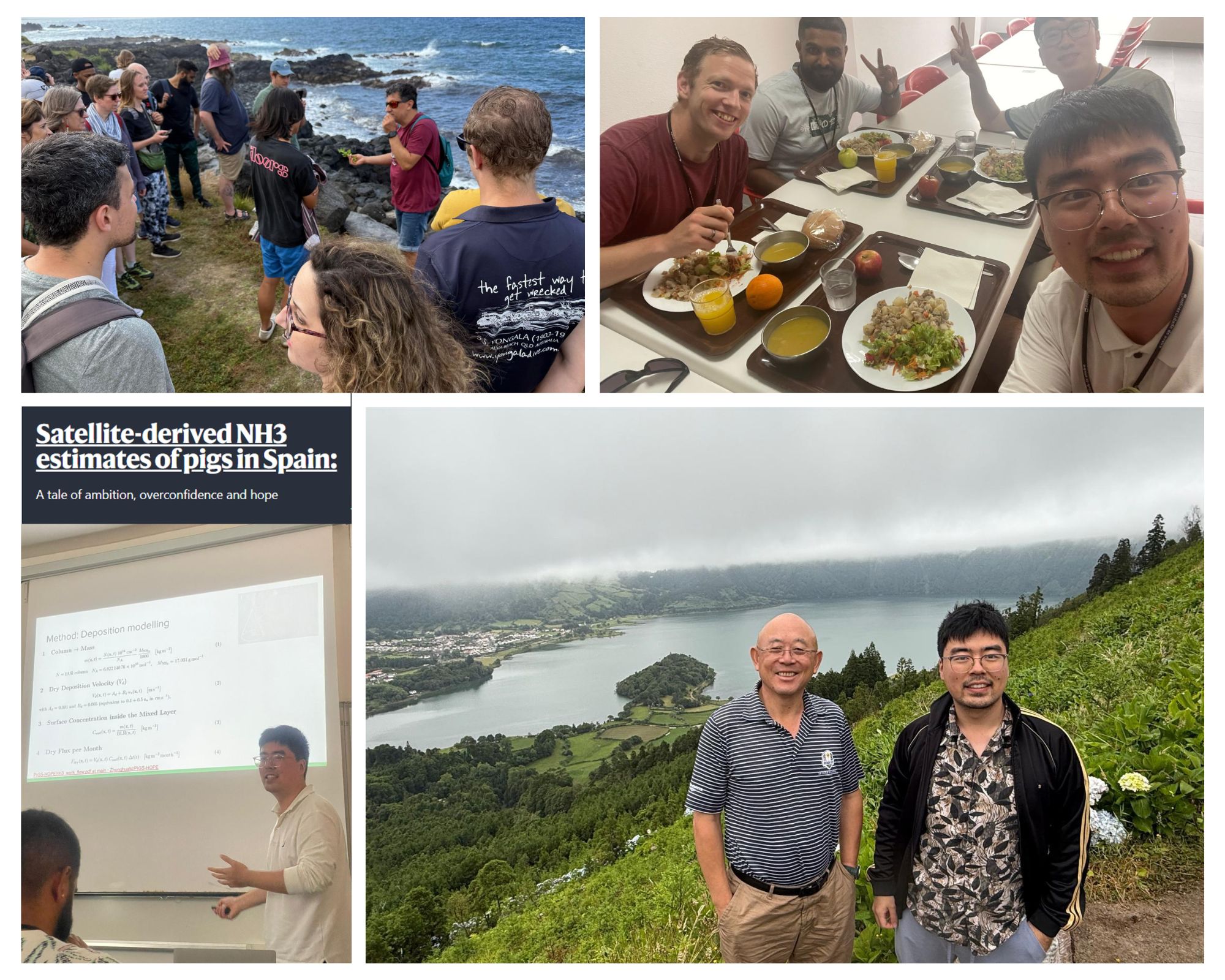
It is mid-European summer in July 2025, the FONDA Twinning Horizon Europe project has headed to the islands of Azores for this years’ Summer School. The Islands are volcanic, lush and roughly 2.5 hours west of the Portugal mainland. Azores and specifically the island of Sao Miguel, boasts large industries in dairy, fisheries and tea. Our very own PhD student Zhonghua Ma, Associate Professor Shu Kee (Raymond) Lam and Professor Deli Chen were lucky enough to find themselves in the middle of the Atlantic Ocean at the host University of Aveiro.
Zhonghua revealed that the landscape was dotted with stunning lakes and mountainous volcanic slopes. The mountains had cascades of streams, rolling down through watermills that ground grain with each turn. There were also small sugar cane plantations as well as pineapples and other crops. The air and water quality are heavily monitored by data stations making Sao Migel an ideal setting to learn about emissions and atmospheric changes.
Education and training was provided to roughly 25 students by 15 highly experienced researchers, on the topic of satellite-based nitrogen deposition sensing in agriculture. Whilst also looking at how to interpret the remote-sensing data and validate and develop modelling.
Prof. Lam and Prof. Chen were there as students, alongside Zhonghua Ma. They immersed themselves in the morning lectures and afternoon workshops. The Summer School ran from the 14th July to the 23rd July and most students stayed in dorm rooms, had lunches and dinners together, went on field trips and built strong connections with both their peers and instructors. Dr. Enrico Dammers from TNO in the Netherlands, was a teacher at the Summer School. Dr. Dammers has extensive experience in the fields of remote sensing and air quality modelling and had a lot in common with the University of Melbourne team, in wanting to calculate and quantify ammonia deposition, even possibly back in Australia.
According to Zhonghua, one of the most enigmatic and engaging presentations was given by Professor Ole Nielsen, an Atmospheric Chemist from the University of Copenhagen, Denmark. Professor Nielsen was old-school in his delivery and shied away from too many PowerPoint slides, preferring to use a whiteboard. He made everyone wear name tags and drew on every student for interaction throughout. Professor Nielsen has been studying atmospheric chemistry since the late 1970s and has a keen interest in the environmental impact of atmospheric particles and pollutants.
The Summer School was a success with Zhonghua and team presenting their research project on “Satellite-derived NH3 estimates of Pigs in Spain.” The presentation was insightful, full of engaging modelling (is “engaging-modelling” not an oxymoron?) and investigated how much truth could be taken from the data, how to develop and improve in the future, and the team somehow made the presentation comical as well. Several field days at the summer school included trips around Sao Miguel and to some of the botanical gardens (there are five in the Ponta Delgada area) where once wealthy landowners had imported all manor of plants including some native Australian varieties.
For more information: FONDA website. Thank you to Zhonghua Ma for your insight.