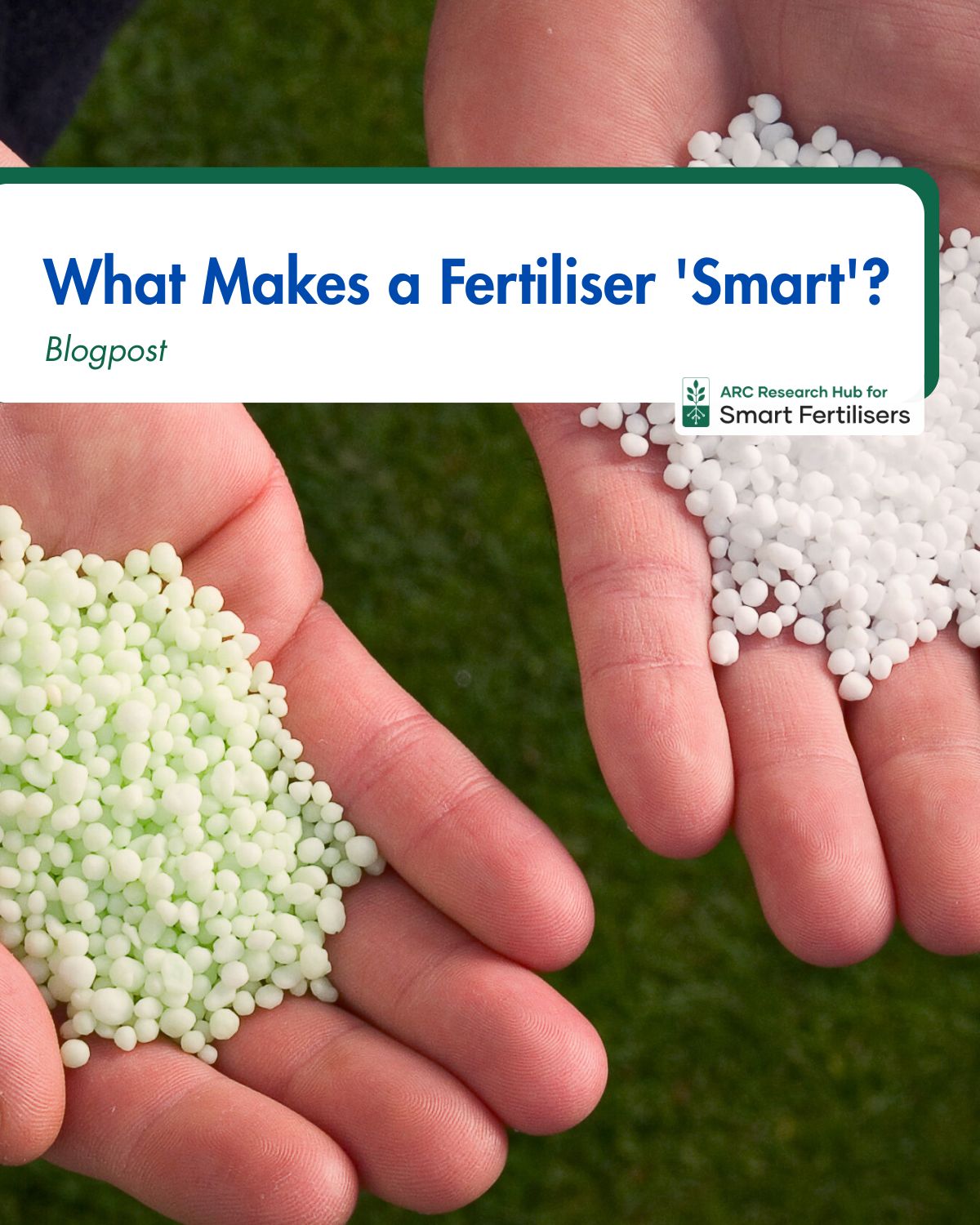
What Makes a Fertiliser ‘Smart’?
Part 2
When you hear the term “smart fertiliser,” you might picture high-tech sensors or AI-powered agriculture. While technology certainly plays a role, the real intelligence in smart fertilisers is about designing fertilisers that respond to the soil and plant environment in ways that match natural growing cycles.
So, what exactly makes a fertiliser “smart”? Let’s break down the science.
The Problem with Conventional Fertilisers
To understand smart fertilisers, we first need to understand why we need them. When you apply conventional fertiliser to a field, it’s like releasing a flood of nutrients all at once. The problem? Plants can’t use nutrients that quickly, and what they don’t immediately absorb is vulnerable to loss through leaching, runoff, or volatilisation, causing a myriad of downstream economic and environmental impacts.
Research shows that up to 50% of conventional fertilisers are lost once applied to agricultural soils due to these processes or remain in the soil matrix due to poor nutrient use efficiency. That’s not just an environmental problem, it’s an economic disaster for farmers paying for nutrients that never reach their crops.
Enter Controlled-Release Technology
Smart fertilisers, more technically known as controlled-release fertilisers (CRFs), work on a fundamentally different principle. Instead of dumping all their nutrients at once, they’re designed to release nutrients gradually over time, matching the pace at which plants actually need them.
The key to this technology lies in engineered coatings that act as barriers controlling how quickly water can penetrate the fertiliser granule and how quickly dissolved nutrients can escape. We can think of it like a time-release medication for the soil.
How the Release Mechanism Works
The science behind controlled release is complex and varies, but it follows a general pattern with three distinct stages:
Stage 1: The Lag Phase When a coated fertiliser granule first contacts moist soil, water begins penetrating the coating. During this initial period, which can last days to weeks depending on the coating, very little fertiliser is released. This lag time is crucial because it prevents the initial nutrient surge that causes so much waste in conventional systems.
Stage 2: Steady Release As water continues penetrating the coating, it dissolves the fertiliser core and creates osmotic pressure. The coating swells, and nutrients begin diffusing outward at a relatively constant rate. Because the concentration inside the granule remains saturated, the diffusion to soil is steady and predictable, exactly what growing plants need.
Stage 3: The Decay Phase Eventually, most of the fertiliser dissolves and releases, reducing the concentration gradient and slowing the release rate naturally. In well-designed CRFs, this final phase occurs when crops’ nutrient demands are also declining.
The Coating Makes the Difference
The magic is in the coating material. Modern smart fertilisers use various approaches:
Synthetic Polymer Coatings: Thermoplastic resins like polyolefin create durable barriers that control water and nutrient movement through diffusion. Different polymer thicknesses and compositions allow manufacturers to design fertilisers with release periods ranging from weeks to months. Some advanced formulations use materials with temperature-responsive coatings which has a permeability that changes with soil temperature, releasing nutrients faster when soils warm and plants are actively growing. However, polymer coatings are of increasing concern due to the impacts of plastic accumulation in the soil and its potential effects on soil organisms and soil properties.
Natural Biodegradable Coatings: Recognising environmental concerns about persistent polymers, researchers are developing coatings from natural materials like starches, proteins, and bio-based polyesters that break down naturally in soil.
Other inorganic and organic materials: Inorganic materials including sulfur, and bentonite and organic materials such as biochar, rosin, and polyphenol have also been studied as viable slow-release fertilisers to varying potential, with varying ability to promote soil chemical and biological, and physical properties.
Learn more about our ongoing research at the ARC Research Hub for Smart Fertilisers
Stay tuned for Part 2