Nitrogen Losses, Trade-Offs, and Mitigation Potential in Global Sugarcane Cropping Systems
Abstract
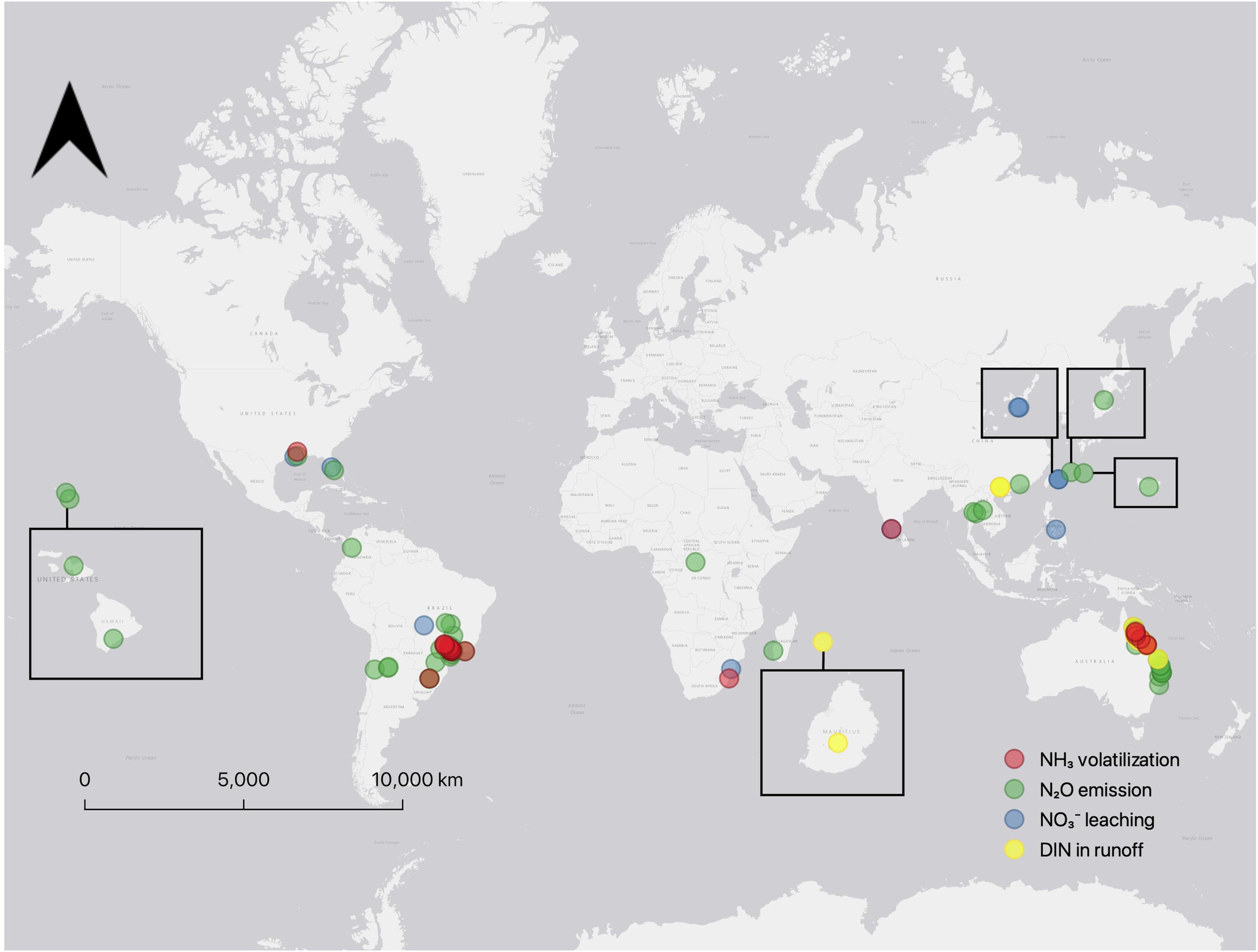
Excessive nitrogen (N) inputs in warm and wet sugarcane cropping systems lead to substantial ammonia (NH3) volatilization, nitrous oxide (N2O) emission, nitrate (NO3−) leaching, and dissolved inorganic N (DIN) runoff, posing risks to air quality, aquatic ecosystems, and climate forcing. A global, integrative understanding of the drivers of these loss pathways and the effectiveness of management practices is required to balance sugarcane productivity with reductions in environmental N pollution across diverse sugarcane regions. Here we synthesized data from global sugarcane experiments to derive region-specific emission factors (EFs) for multiple N loss pathways and to identify key biophysical and management controls on N losses, crop yield, and their trade-offs. Brazil showed the highest NH3 volatilization EF (7.4%); Australia the highest N2O emission EF (2.6%); and Brazil the highest NO3− leaching EF (8.9%), highlighting strong regional contrasts in N loss dynamics. Across regions, N application rate and cane trash retention were major regulators of NH3 volatilization, with surface trash retention overriding soil pH and clay effects. N2O emissions increased with high N inputs and carbon availability, but were negatively associated with water inputs, suggesting enhanced complete denitrification under wetter conditions. High N and water inputs increased DIN runoff. Increasing N input enhanced sugarcane yield but also amplified all major N loss pathways. Cane trash retention increased yield but raised NH3 and N2O losses, whereas adding carbon-rich sugar mill by-products reduced NH3 but increased N2O emissions. Urease and nitrification inhibitors effectively reduced NH3 and N2O losses, respectively, while controlled-release fertilizers showed inconsistent impacts. Scenario-based modelling demonstrates trade-offs between N loss reduction and productivity, with urease and nitrification inhibitors substantially reducing N losses without compromising yield, outperforming strategies based solely on N rate reduction or cane trash removal. These findings together inform sustainable N management strategies that mitigate environmental impacts while maintaining sugarcane productivity.