Improving Nitrogen Loss Simulation in Sugar Cane Research
Highlights:
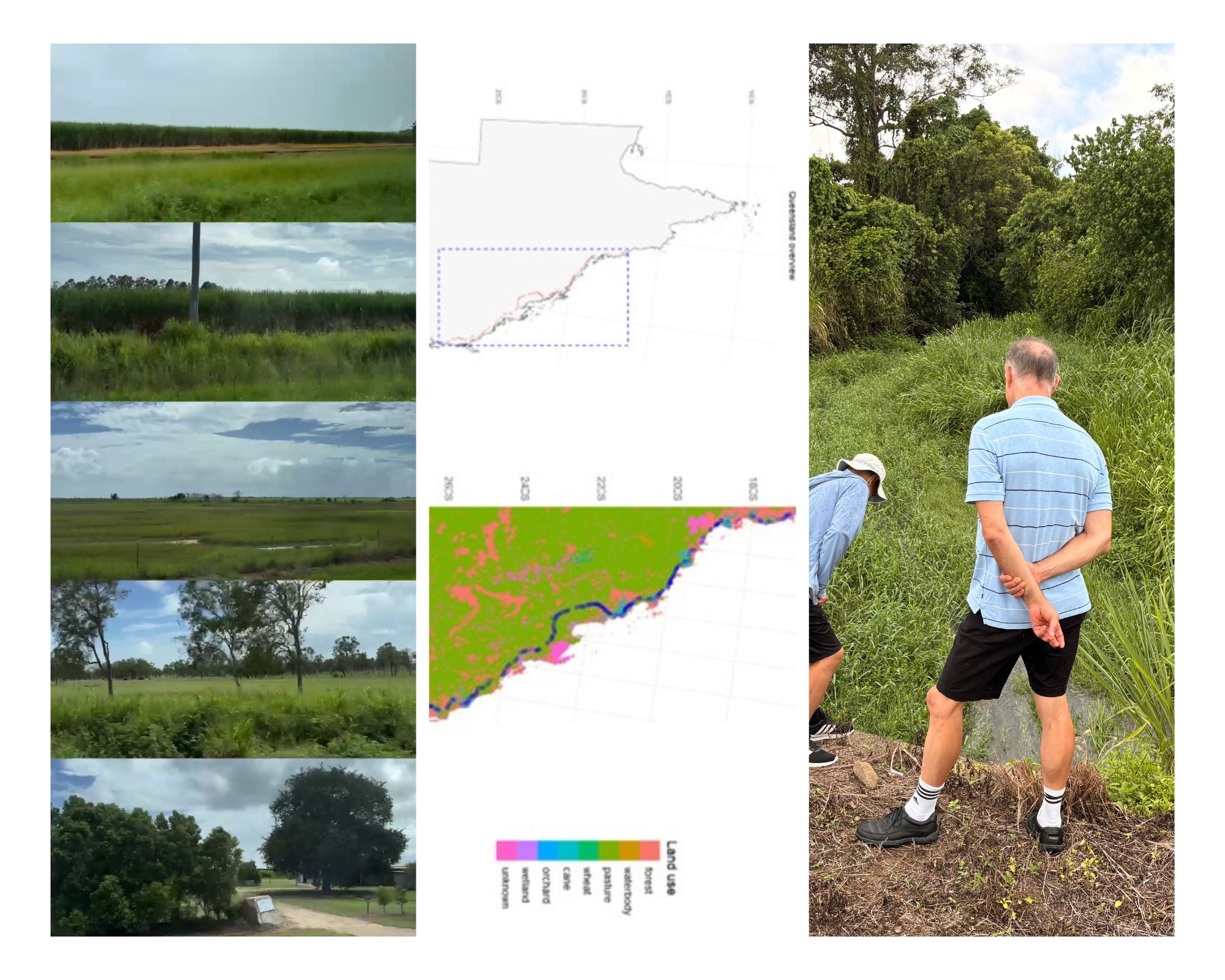
- Over this 2,571 km journey, various land uses and ecosystems across Queensland were observed. For those whose work is often focused on modelling and data analysis, it was especially valuable to see these real-world systems up close.
- Insights and information collected from the visit will help calibrate CNMM for a better simulation and support the ARC Smart Fertiliser Hub’s work on nitrogen management.
A delegation from the Hub recently travelled to Queensland (Feb 2026) for meetings with delegates from the Queensland Department of the Environment, Tourism, Science and Innovation, as well as Sugar Research Australia. The delegation included Deli Chen, Raymond Lam, Baobao Pan, Boris Sarcevic and Jessica Xu, as well as consultant researcher, Yong Li. Mei Bai joined online for fruitful discussions on potential collaborative research with the QLD government and SRA on research and strategies to support modelling work on improving the Catchment Nutrient Management Model (CNMM) for the Great Barrier Reef catchments.
Following the meeting, Yong Li, Baobao, Boris and Jessica embarked on a road trip from Cairns to Brisbane to gain first-hand insight into local hydrological, landscape and farming practices so that they could better calibrate key hydrological parameters in CNMM and improve its simulation of nitrogen loss from different pathways, particularly N leaching and runoff, across the four major Great Barrier Reef catchments (Burdekin, Burnett Mary, Cape York and Fitzroy). They travelled a total of 2,571 km, which also gave them a valuable opportunity to observe the diversity of land uses and coastal ecosystems across Queensland. This broader landscape perspective was especially useful for strengthening the “Paddock → Catchment → Reef” simulation framework and to support better nutrient management with less environmental impacts, which is the goal of our Hub.
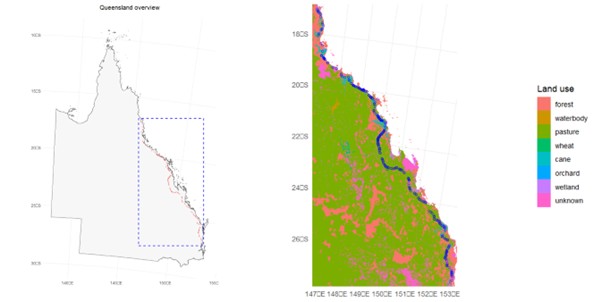
(this is our checking points of each creek, 326 points in total)
From a research perspective, the site visit helped the researchers to connect model assumptions with real-world conditions and provided critical context for parameterization of CNMM and scenario analysis. It was a valuable opportunity to observe the complexity of the Queensland landscape first-hand and to better understand how different production systems, hydrological settings and ecosystems interact to shape nitrogen movement from farms to waterways and ultimately to the Great Barrier Reef. For those researchers who mainly work on modelling and data analysis, seeing the real-world landscape and systems behind the data was especially valuable, and will directly inform how they approach future modelling and the interpretation of practical scenarios.